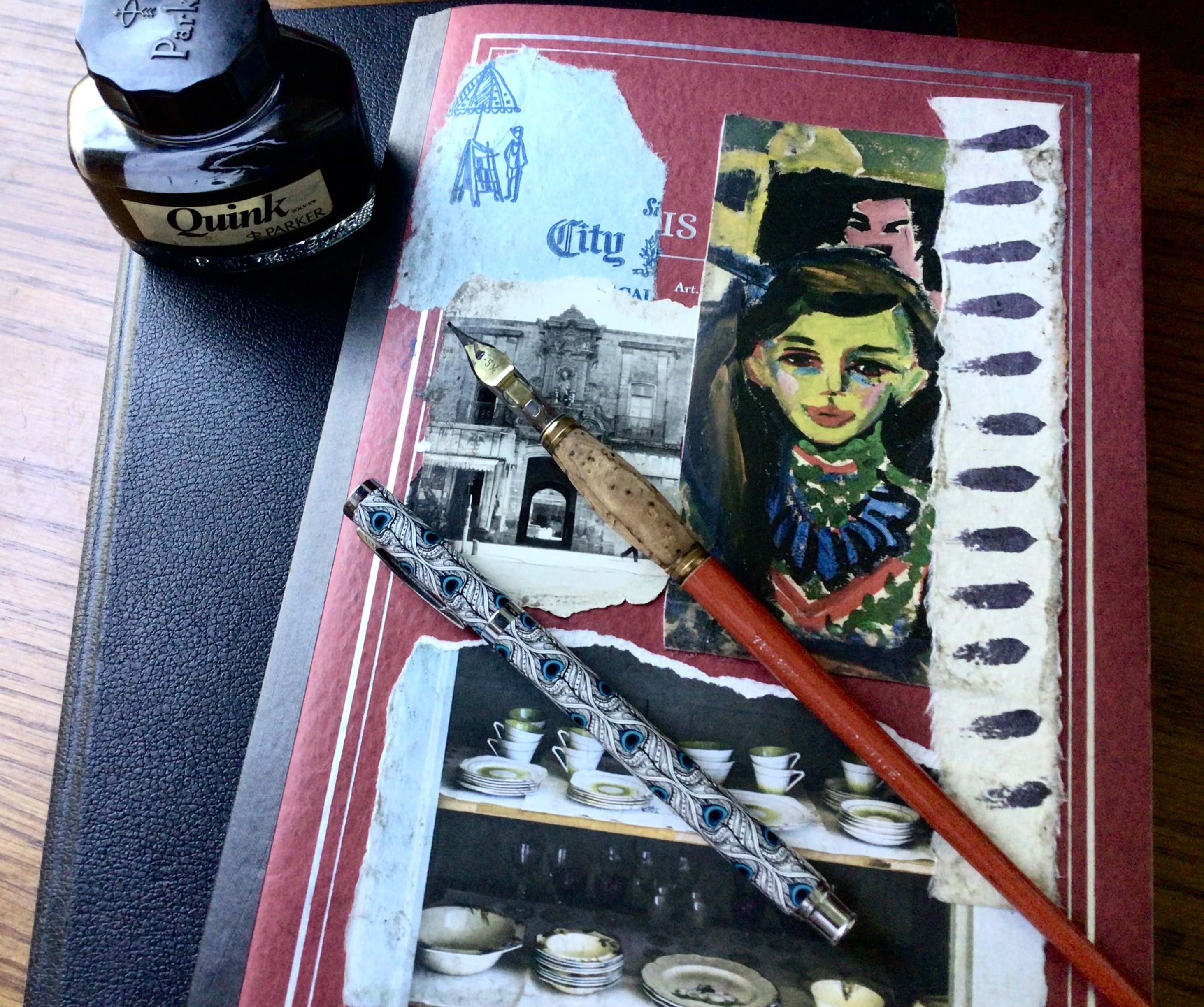
“Write your way home. You know the way.” (My inscription for a notebook I once gave my late friend, Merijane.)
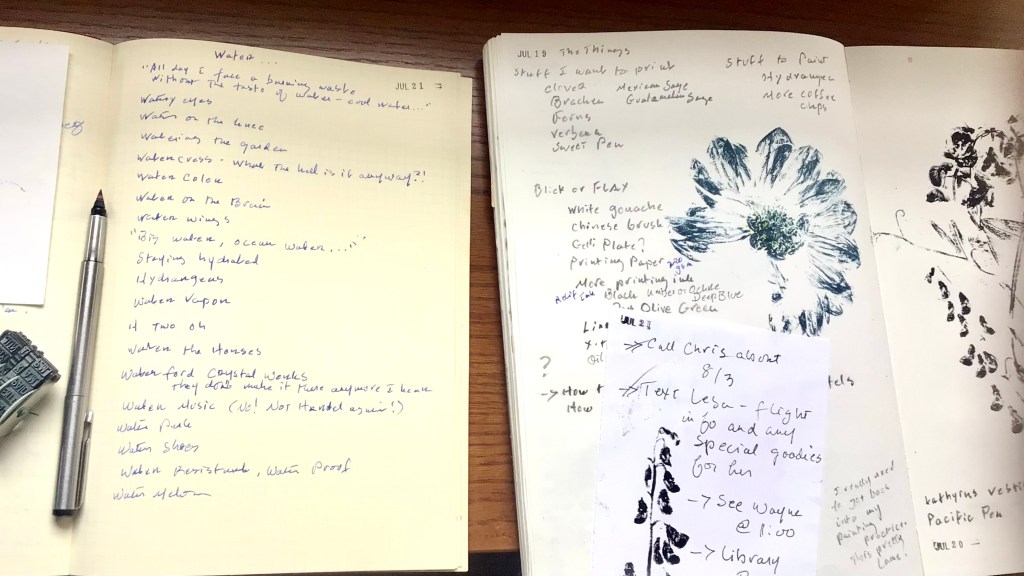
It’s safe to say that lately I’ve been feeling intimidated about writing anything I might want anyone else to read. So I’ve told myself I’m not writing. But there’s that notebook next to me on the desk, the pages filling up with my chicken scratches. I am writing. But there it is again, the demon that stalks us and makes us question our worth. I’m more focused on whether I’m producing something worthy of sharing rather than noticing what’s really happening. I do this all the time, though you’d think I’d know better. Writing and publishing are related, but separated at birth. Publishing is given the spotlight, but it’s a vacuous enterprise without the time it takes to write. It’s the process, the doing of it as regularly as possible. It’s the moment of remembering to myself, “This, this I need to write down, and now.”
I worry about not writing though. Saying I know how to write means I know how to take the mess, or the breathtaking beauty, or the humor of a day, an hour, a lifetime, and try to break it down and make some sense of it — or even to just reflect back the nonsense. It’s the only way I know how to cultivate some kind of acceptance when I’m confused or overwhelmed or even just observing the breathing of a day.
I think the issue of distraction strongly affects my student writers in workshops too. They’ve met the demon already and are so eager to put something out there for consumption. They’re ready to type it all up and look for a way to publish, but are not prepared to sit down, tune out distraction, and put the pen to work on the notebook. And they haven’t, or don’t read books. In Writing Down the Bones, Natalie Goldberg says that writers “fall in love with other writers. That’s how they learn to write. They take on a writer, read everything by him or her, read it over again until they understand how the writer moves, pauses, and sees.” It’s that love affair that keeps the pen moving. There is simply no substitute more powerful for nurturing student writers than a good story. And every good writer I know has a stack of books in every corner of their home. And at least one notebook, at least one favorite pen. Maybe I’m not reading enough either.
There is no piece of writing worth its salt that didn’t take some time. Time not just to write that story or poem or song, but to practice writing for its own sake — for the act of practicing. Most writing, or art of any kind represents a good deal of work done long before anything is produced necessarily for an audience. Writing, like drawing or painting or playing an instrument becomes a matter of ritual, a process of returning to the heart, of coming home. The notebook or the sketchbook is, as my artistic friend Paul Gallo says, is “The safest place on earth.”
Also, it’s the act of writing by hand – without the distraction of constantly revising, constantly editing, that comes with typing. Writing by hand is more personal, more fluid, and ultimately safer, the stakes are lower. And once the process becomes part of the rituals of the day, it becomes more important than any distraction. At times there can be a sort of private sense of urgency about writing. As if, not doing it becomes unthinkable.
Recently someone I care about lost her home and all of her belongings in a fire. As an artist and writer, this means she lost everything she’d produced. But what she held onto is her identity, her need to practice the ritual of writing down those “bones,” of returning home to herself and processing whatever it is she’s observing and experiencing. When I sent her a box of clean clothes, I remembered what seemed obvious, that she’d need for me to send along a notebook and a few good pens. Good, smooth paper and ink that’s ready to skate across the page, leading the way back home. Like my notebook and my favorite pen, waiting for me always on the desk because I need to keep them close.


 elizabethlevett
Leave a comment