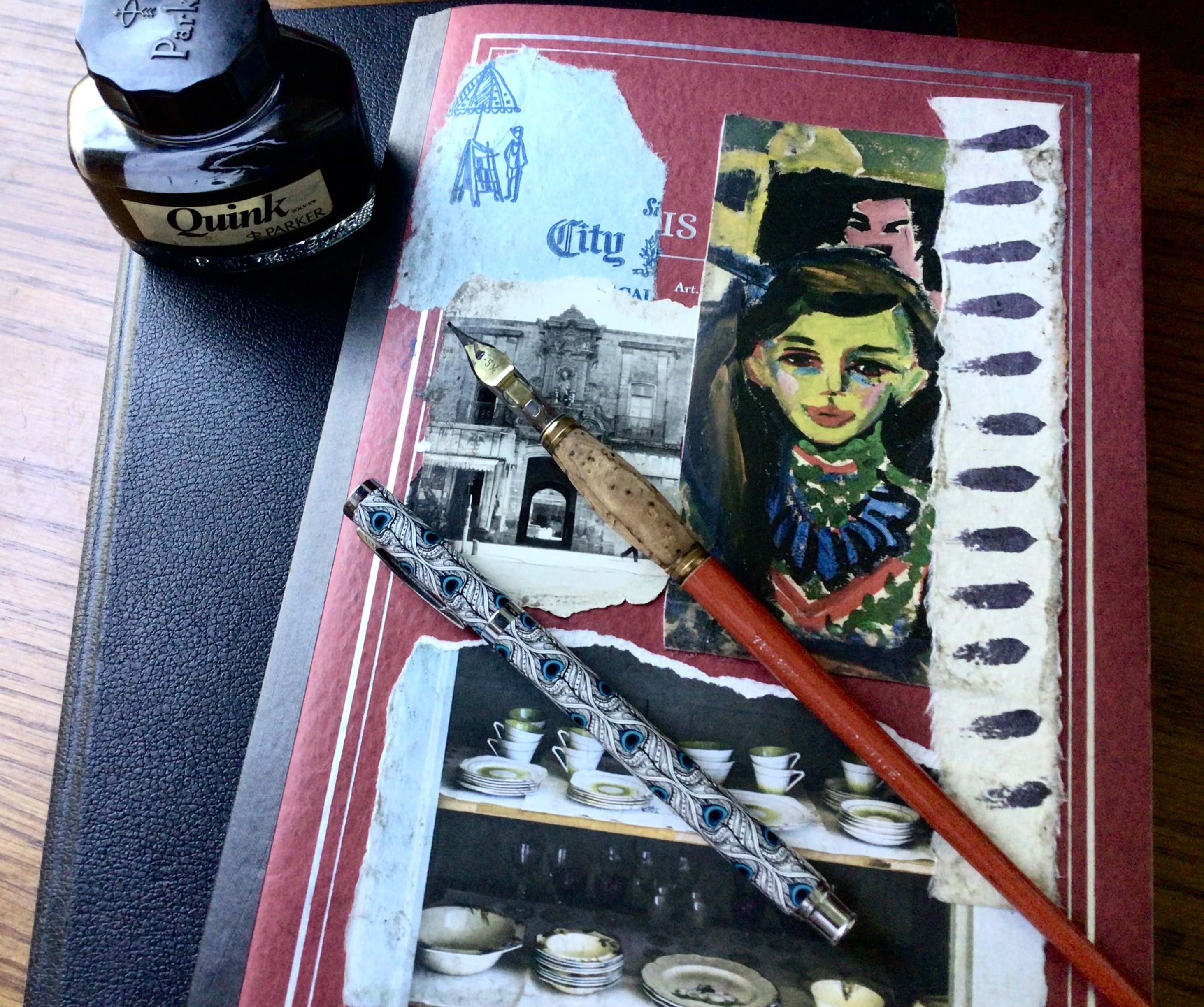
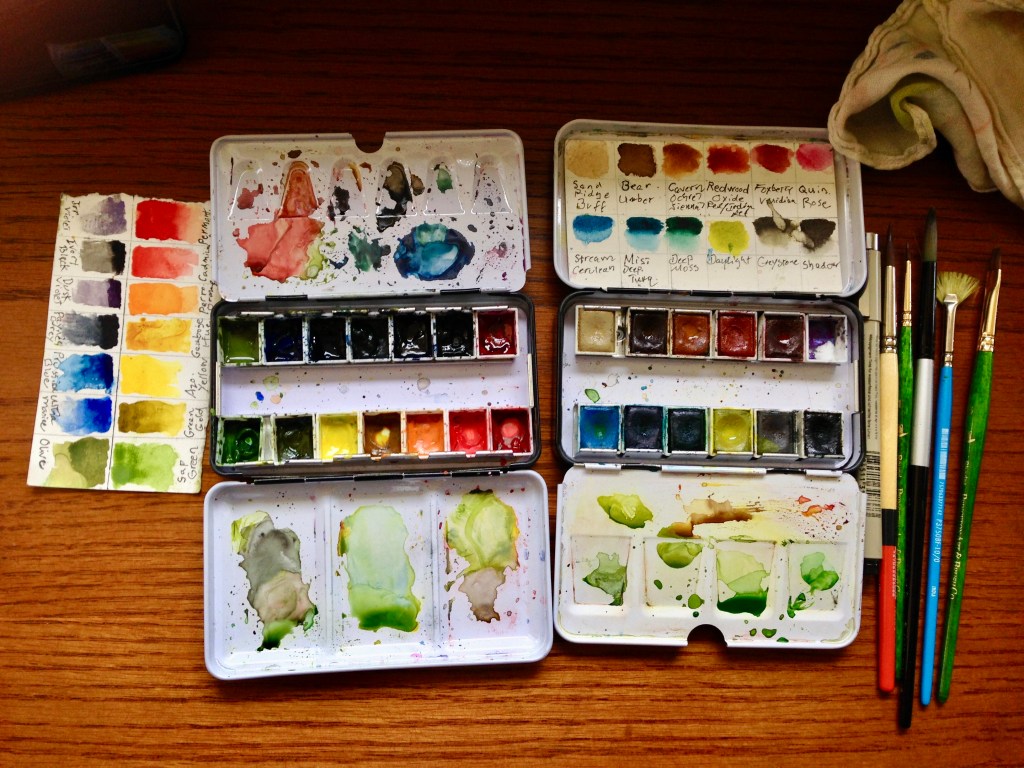
I want to paint today. I try to spend a little time painting every day. I love it. I love painting almost as much as shopping for new watercolors or gorgeous brushes. My obsession with painting and other forms of visual art goes way back. At some point I fell in love with watercolor. In college I embarrassed myself with lots of romantic scenes in miniature — ocean waves in the cove, moonlight, the usual. I really had no idea what I was doing. Most of the paintings turned out flat and childish.
At some point the 1980’s happened and I told myself there was nothing to being an artist really. All I had to do was dress myself in the tawdriest get ups I could assemble from the thrift stores, get a few inexpensive tubes of watercolor paint from Chinatown, and set up an easel with a huge pad of cheap newsprint. I didn’t really own good brushes in those days. Then came all those years in between with grad school, forming a band, falling in love, and working my arse off to survive. It would be decades before I’d learn how to produce anything with a spec of nuance, a hint of lightness. After all, I had to buy cute clothes for work, BART fare for rehearsal nights, and a good microphone that didn’t smell of beer like the ones in the studio. I would do quick sketches using the tube as a pen. I loved the results; they were so expressive, the color laid on thick and careless.
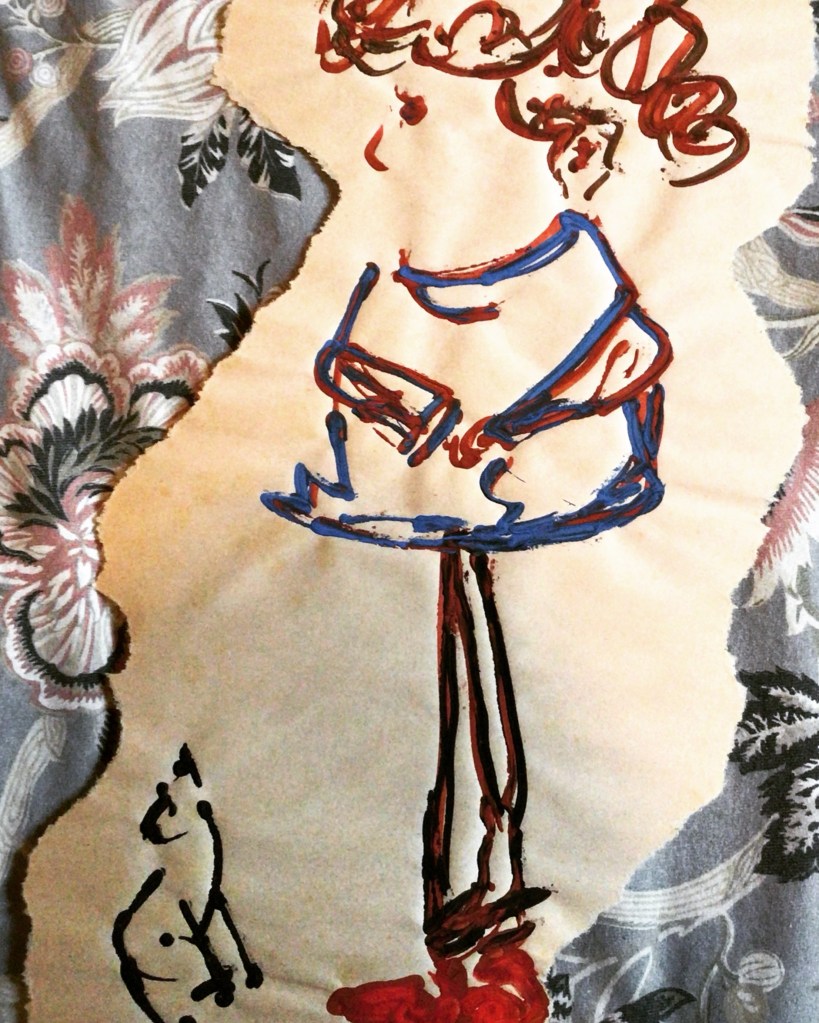
The problem of course, was that the thick paint pulled the paper out of shape when it dried, and the edges eventually crumbled away. So much for my fame as an abstract portrait artist. (“What does it all mean? I heard she never even took a class!”)
When you teach little kids, you naturally draw and paint. Likewise, when you design your own album covers. Then there were occasional projects around the house from time to time — Christmas cards that one year, the giant flying orange cat triptych for the living room of our first apartment. It’s amazing how the days crawl and race at the same time. Then you retire.
I told myself I’d finally learn to paint now that retirement from full-time teaching would allow the time, and I had the funds to buy good paint, cold-pressed paper of sufficient weight, and some round brushes of varying sizes with nice pointy tips. I even made a pilgrimage back to Chinatown for a few of the old-style calligraphy brushes and found some online teachers and books. One book on loose watercolor florals was extremely helpful and I set about to try every flower the teacher suggested over the course of a few months.
Here’s what I learned that I had never realized. Watercolor painting isn’t simply painting with water-based paint. The paint is only half of the equation. You have to use water as a tool in and of itself. Eureka! You can even “paint” and area with water and then drop in the fully saturated color and watch how the two dance together on their own, creating gradients of light and shadow. The magic of it is intoxicating and the results are amazing.

But I want to paint more than flowers. The crazy, tawdry girl of the 80’s still peeks out of me at times. She’s still in love with Franz Marc and his blue horse, with Henri Matisse and his joyful cut outs. I have to let her play while there’s time. She is many things, but she is no realist. Besides, some days reality is not all it’s cracked up to be. And again, whenever I try too hard, spend too much time trying to perfect a sketch, it turns out appearing flat and childish. Sometimes nothing works. I’m convinced that this is a good thing. If a thing is too easy and you always get what you expect, magic has no place. Part of the meditation is in letting go of the outcome and allowing for surprises. I have a feeling this is far more important than just being able to paint a pretty picture.
The internet is a wonderful thing. And the library is full of books. I’m constantly on the hunt for new painting techniques to try and the galloping blue horse of time tells me to get on with it. I’ve been painting with a wider variety of brushes, but also with sticks, spoons, the edge of my library card, small wads of paper, and even crinkled up plastic wrap. I’m excited to learn more and to keep playing with painting, a perpetual beginner, eager to try out a new technique, a new brush, a new way of blending colors. What does it all mean? I have no idea. Except maybe I’m just in love with water and color and the things they can imagine with me.
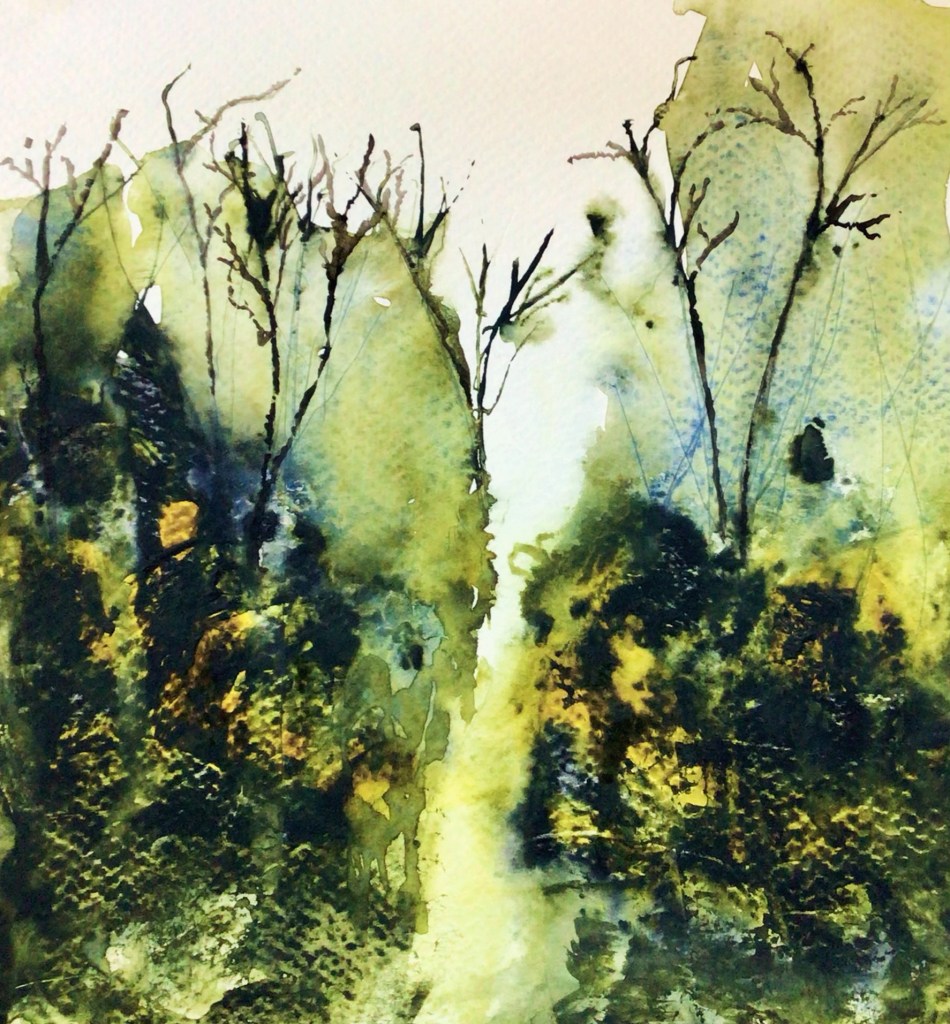
Some things I’d recommend in case you want to get on this ride with me… 1. Cold-pressed paper like Fabriano’s 140 lb/300 gsm; 2. Round-tipped brushes in sizes from 1 through 8; 3. Two jars or small bowls of water – one for cleaning off the brush and one to keep absolutely clean for using on the paper itself; 4. Sticks, feathers, plastic cards, anything that can be dipped in paint; 5. A #2 pencil or even an “H” drafting pencil in case you want to sketch first and a kneaded eraser. (A normal eraser can damage the surface of your paper, while a kneaded eraser just lifts off the graphite.) 6. A couple of fun art books to help you push off from the dock. I love In Pursuit of Inspiration, by Rae Dunn and In and Wash Florals, by Camila Damsbo Brix.
Finally, I suggest making some time each day to practice and to fool around! It’s not about perfection or product, it’s about process and play. (And some patience with yourself helps too…) Get a good sketchbook or file to keep your stuff in. That way, you can look back and see how far you’ve come. I like to put a few good quotes in the front of my sketchbook… “Once in a while I make a masterpiece, but usually, I just make a mess.” – Christine Castro Hughes. “Art washes away from the soul the dust of everyday life” – Pablo Picasso. And, my dear friend, designer and teacher, Paul Gallo says, “My sketchbook is the safest place on earth.” Now, go play with water and color.
 elizabethlevett
Leave a comment