
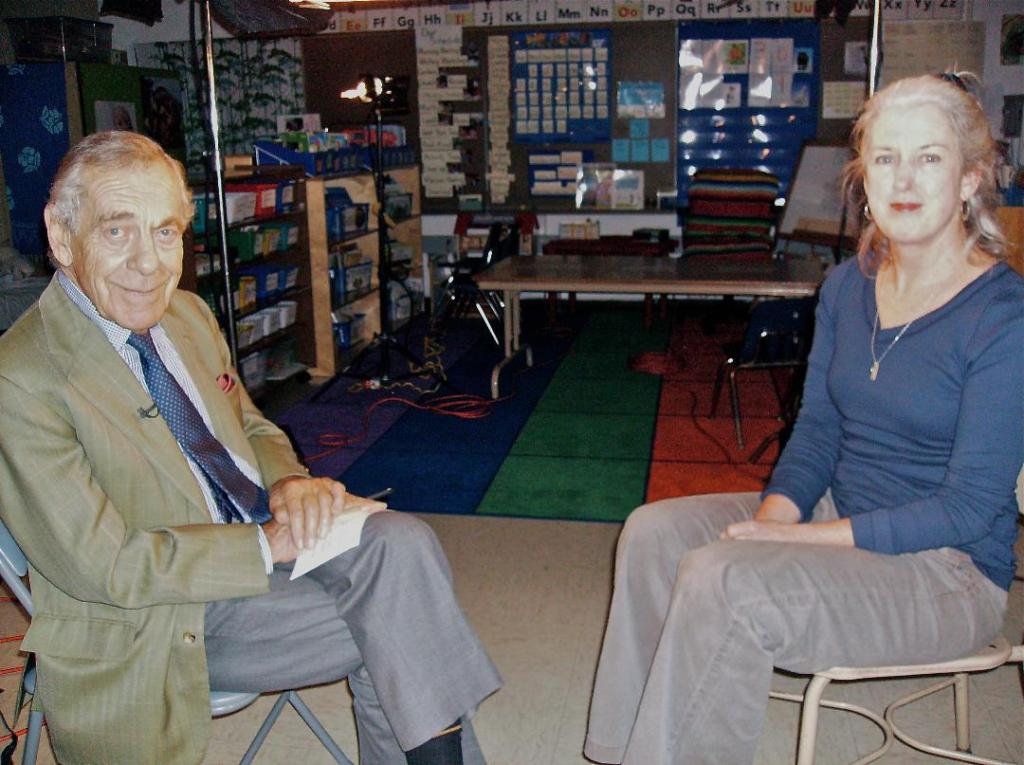
Teacher voice is an issue I’ve thought about from time to time. We may well feel strongly about a given issue. We wait and watch for a chance to speak from our experience, to say things we know are true and really be heard. Some years ago I hosted a journalist from the New York Times in my classroom. It was a favor for a friend. The Times reporter wanted to talk with me about the issue of red-shirting, that is, the practice of parents holding their children out of kindergarten until the age of six to give them a chance to do better in school than those who begin at five. I was excited about the chance to maybe say something quotably intelligent about an issue that is close to my experience.
The reporter stayed in my classroom and talked with me for over an hour about the complexities involved in parents’ decisions regarding a child’s readiness to enter school. We had what I thought at the time, a fairly meaningful conversation about the issues that parents and caregivers face as they navigate the ins and outs of ensuring a good education for their child. She noticed the wide range of ability levels in my inner-city, first grade classroom. There were students who were reading at or above grade level working alongside youngsters with very little experience of books or knowledge of letter sounds.
I was careful not to speak in general terms, as I knew even then that much of the substance of our conversation might ultimately not make it into her article. I did express my frustration at the fact that some children come to school too young and under-prepared for the rigors of a full school day, while others are kept at home or sent to private preschools where they receive a thorough preparation for early learning.
At one point near the end of the visit, I made one off-hand comment about children who are not prepared for classroom behavior expectations like lining up, waiting to be called on, listening quietly to others. It’s actually easier to deal with deficits in reading readiness than with the behavior of children who have been at the center of a family’s attention, and have not learned to occasionally experience delayed gratification. My comment was this: “We see children who have never even lost at Candy Land.” And guess what, when I read the article, that single comment was all she used of our conversation. Swell. Without context my statement seemed thoughtless and uncaring. The worst of it was that I was quoted in lots of other, local papers. My fifteen minutes of shame.
Years later I started working as a kindergarten teacher in San Francisco’s Richmond District. Again, I worked with an ever-broadening range of student readiness. Again, I grappled with the reality that families with resources are able to keep their children at home and offer them all kinds of enriching educational experiences before sending them to school. Many of these families invest in high-quality, preschool placements for their children. Upon entering kindergarten, the students are often six years old and some are already able to read. They come to school with younger children who may not be ready, may not yet know any letter names or sounds. Teachers of young children know that they step along the milestones of school skills according to a subtle path of development that may or may not proceed with the predictability of their next birthday. The difference is almost always a matter of the resources that are more available to some families.
One very busy day I get an excited look from the school secretary. She tells me to look in my box for a phone message. The message is from “Sixty Minutes.” When, after a series of exchanged messages, I finally get a chance to talk to the woman from the famous TV news program, I’m told that she is eager to have me speak with Morley Safer on the subject of red-shirting. Seriously? It seems they saw my quote in the New York Times. Oh boy. I tell her that yes, I did have a conversation with a writer who did a piece for the Timesand yes, I would be willing to talk.
She originally contacted me in May, just before the end of the school year. Taping was to take place in my classroom in the coming August. Over the course of several months we discussed the matter at length, and there was one point I made sure to emphasize. I told her I had felt burned by the Timesinterview and did not wish to be taken out of context or misrepresented. She assured me everything would be fine. Silly me, I believed her. Come on, it was Morley Safer. Someone I admired as a perceptive journalist and a nice man. Heck, he’d covered so many important stories. He’d been in Saigon during the war when I was a kid.
The camera guys, the woman from the phone call, and the rest of Morley’s staff showed up before school and were in my classroom ALL DAY. They took pictures. They filmed my kids at lessons, doing their work, playing outside, and even lining up. My kids were awesome. And it was only August! Bless them. Children are so tolerant of us, after all.
After the kids went home, the camera guys did a few long shots of Morley and me walking across the windy playground. Then it was time for our interview. I got my nose powdered by a very nice lighting tech. My windows were covered with black stuff, lights were hung, and the furniture and books were re-arranged. The stage was set. Morley and I sat facing each other on little classroom chairs. We sat for a surreal and silent moment, as lighting levels were set. I said something that made Morley laugh. (And dearly wish now I could remember what it was.) Then we started our interview conversation. “You’ve been teaching young children for a long time, right?” Yes, a long time. “A long, long time.” Yes. Alright, already. When you’re being taped for a national news program and the opening line makes you feel a relic, things really could be going better.
Morley brought up the range of students in my classroom. Yes, some are very well prepared. Others are not ready for school at all. Some are tall and some are tiny. (As proved in the line-up shots of my kids.) “That must make your job very difficult.” This was where our dance began. We were parallel lines, not intersecting. Sorry, Morley. I was not about to complain about my profession, of which I’m actually quite proud. I was not going to whine on television. “I don’t expect my job to be easy,” I said. “Good teachers know how to differentiate instruction,” I said. Morley’s kind and crinkled smile collapsed into a furrowed frown of frustration. His face would fall again several times as our talk continued that way over the course of an hour in my sweltering classroom.
I explained that the real shame, as I see it, is that it is a difficult situation for the children. I told him how the younger ones usually end up in school too early because their parents don’t have the resources to keep them at home. When families don’t feel they can help their kids at home, and they have to work, they want schools to take care of their kids. They needschools to take care of their kids. As a result, these very little kids learn, right away, the most obvious and sobering reality of education: that someone else has more and is therefore doing better, finding things easier, than they will. It’s no wonder then that parents who are able will find ways to hold their kids out a little longer. They believe, or know, that an extra year will give their kids “an edge.” The response was pretty lukewarm, though I was dancing nervously in and out of hot flashes. My comments about social and economic inequality were not what Sixty Minutes was looking for. I get it, they had an important story to tell and I was supposed to help them tell it. But my strong sense was that telling their story might well put me in a position of compromising my own.
Morley also asked me about “helicopter parents,” those that hover over their children, over-protecting them and butting in at school. Again, I chose to be a little guarded in my response. I don’t take lightly the trust of parents I work with. That trust is vital to their child’s success. I told Morley that it’s important for me to listen to parents and reassure them. Another long face. I can deal with a little butting in now and then, it’s the pressure on children to compete that I want to somehow protect them from. In some cases, it’s childhood itself that needs to be protected.
In the end, Morley Safer and his team were pretty disappointed in me. In the end, my hair was a disaster and I’d worn the wrong thing. (Though I must say red lipstick photographs beautifully.) In the end, Morley Safer let one of my teacher buddies give him a hug and submitted to a photo with my administrator and me. In the end, a famous television personality was very nearly run down by the Number 44 bus while running for his taxi clutching a cigarette. In the end, they decided not to air our interview, but showed only a brief clip of my classroom. I did not get to have a sterling interview on “Sixty Minutes.”
The complex reality is that education is not yet the great equalizer, the great leveler, that we work hard to make it. The issues that families face can’t be neatly compressed into a twelve-minute news story. And, as it turns out, our voice, our visibility is in what we do. Our opportunity lies in continuing every day to offer fairness, innovation, and compassion. Most importantly, we do better to spend our time listening and working with families than attempting to sound clever when we are given a chance for our voices to be heard.

 elizabethlevett
Leave a reply to teeeach11 Cancel reply