Once upon a time I got to feed John Cage, a memory I hadn’t given light to in a very long time. Until last week. I was listening to the radio and In a Landscape came on. It’s a very beautiful piece, written in 1941 when John Cage was at Black Mountain college. The classical station was playing an arrangement of the piece on harp, something I hadn’t heard before.
John Cage was a lovely, gentle man with big, soft hands. Nearly a lifetime ago, I was in my late twenties, with wide eyes and a desire to reinvent everything – art, music, love. And I was a volunteer. I was surviving on temporary office work after leaving the employ of a slimy and mean-spirited attorney in Oakland and I was ready to conquer the city, or at least charm its pants off. My volunteer job was at an arts organization south of Market Street. This was in the 1980’s, when people like me could afford to keep an apartment as well as a studio space to rehearse with the inevitable band we’d formed with friends from college. Art Com/La Mamelle/Contemporary Arts Press had impressed me when I visited, and I impressed myself by signing up to work there. They published books on Mail Art (Correspondence Art) and Performance Art (Performance Anthology) and put out a contemporary arts magazine which eventually became one of the first to go online. There was also a huge and beautifully lit space for performance art. I got to help in the office and meet cool people – artists who may not have been famous in the mainstream, but most commanded at least a modest cult following. (The Residents, V. Vale, Cavallini, Anna Banana…) I was taken to lots of art shows (free food!) I even got to publish my first real piece – a summary and review of the LA Museum’s recent exhibit guide — an impressive publication called, The Spiritual in Art – Abstract Painting 1890-1985. This was a stunning, 435-page survey of painting and commentary on so many important artists – Kandinsky, yes, but also Mondrian, Hilma af Klint, O’Keefe, Gaugin! For a girl in love with art and philosophy, I felt I was really doing something. I plunged myself into the project, cranking out a whopping ten pages of the most pretentious, most intellectual piece of writing I’d ever poured myself into. I was on top of the world.
Art Com also gave me a few performance opportunities. One was a Film Noirish themed “casino night” with guests dressed to the nines. I had to find the sheet music for some classic old torch songs. This led to an interesting visit with an elderly woman in a walk-up apartment off Hayes Street. Her rooms were stacked with music from floor to ceiling and I lost count of the fire hazards. But she allowed me to take her cherished sheets of “I’m Through with Love,” “Guilty,” “Every Now and Then,” “One for my Baby,” and a few other tunes around the corner to photocopy — holding onto my ID for security. After rehearsing some old standards with the band, and recording an instrumental track, I stitched together a slinky torch singer sheath dress from shimmery bronze fabric and jammed a gardenia behind my ear to perform my vocals live over the recording — live and alone at the mic for the first time.
Then there was an afternoon our band was offered use of the gallery to host a release party for our new recording. Only one issue came up – we had a long block of time to fill and about an hour’s worth of songs. Nothing to do but knuckle down and get some writing done. Each of the four of us came up with twenty minutes of material and we compiled an hour’s worth of ambient music to play before the live set. We served fancy iced tea and whatever treats we could throw together on our budget, but it was truly our day.
One afternoon, I was told that the celebrated composer, John Cage, was in town and would be coming to Art Com for a special reception. There would be lots of interesting and cool people around and plenty of food. I was beyond excited. John Cage. A real experimental composer. I decided I’d have to get up the courage to give him a cassette of our music. I was also told, pointedly, that I could bring some food to contribute. I was a kid, a volunteer. I would bring whatever I could make on my own along with a copy of our most recent four-track recording. Honestly, I didn’t know that much about John Cage. What I knew was that he was influential, and interesting. He was an artist who pushed boundaries, tried new things, reached people with his work. He represented something important to me.
When the date finally came, I threw together the edgiest outfit I could come up with and hustled out to the train with some crusty, seedy wheat bread that I’d baked, a big bowl of home-made hummus, and my tape – complete with a carefully designed collage cover. When I finally made it to the gallery there were cool people all over and an impressive spread of cheeses, crackers, wine, and fancy hors d’oeuvres. My bread and hummus seemed like poor cousins at the table. I was too nervous and felt way too uninteresting to make conversation with the guests. After all, I wasn’t really anybody. Finally, John Cage came in with his assistant. All I could do was stare as he moved through the crowd, talking graciously with the directors and the other artists who’d come out to meet him. When he got to the food table I watched as he considered the options, so many choices. They’d gone all out – it was truly impressive. In the mid-1980’s nobody used the word “vegan.” But John Cage followed a lifestyle of abstaining from things like brie and prosciutto. Who knew? All he ate was the seedy whole wheat bread and home-made hummus. This private triumph was nearly too much for me. He assured us that it was all he really needed.
John Cage didn’t stay long, and I was ready to leave when he started moving for the door. I waited in the awkward silence of the stairwell alone for several minutes before he came down, almost certain he wouldn’t want to talk with me. But opportunity is a some-time thing, and this one was all mine. As he came down the long stairway, I asked if I could give him some of our music. He was even kinder than I could have imagined – the absolute soul of humility. He took my cassette, studied the cover, and tucked it away in his jacket. Then he gave me his hands – his big, incredibly soft hands – and was gone.
I have no memory of getting home that night, but I must have been an hour on the bus and the train to make it back across the bay to my apartment. Too keyed up to sleep, I decided to play one of my extra copies of the tape I’d given to John Cage. I turned on the old boom box, pressed play, and waited. Nothing. Absolutely nothing. I had most probably given a blank tape to John Cage, the soft-voiced composer who had shocked the world with 4’33”, a piece in which the score calls for the musicians to refrain from playing for four minutes and thirty-three seconds, a score of silence. I’d given him 60-minute cassette of silence. All I could do was laugh. And pray that he was somewhere laughing too. At least I’d given him food. I had fed John Cage and received his beautiful soft hands, and his kindness. It was all I really needed.
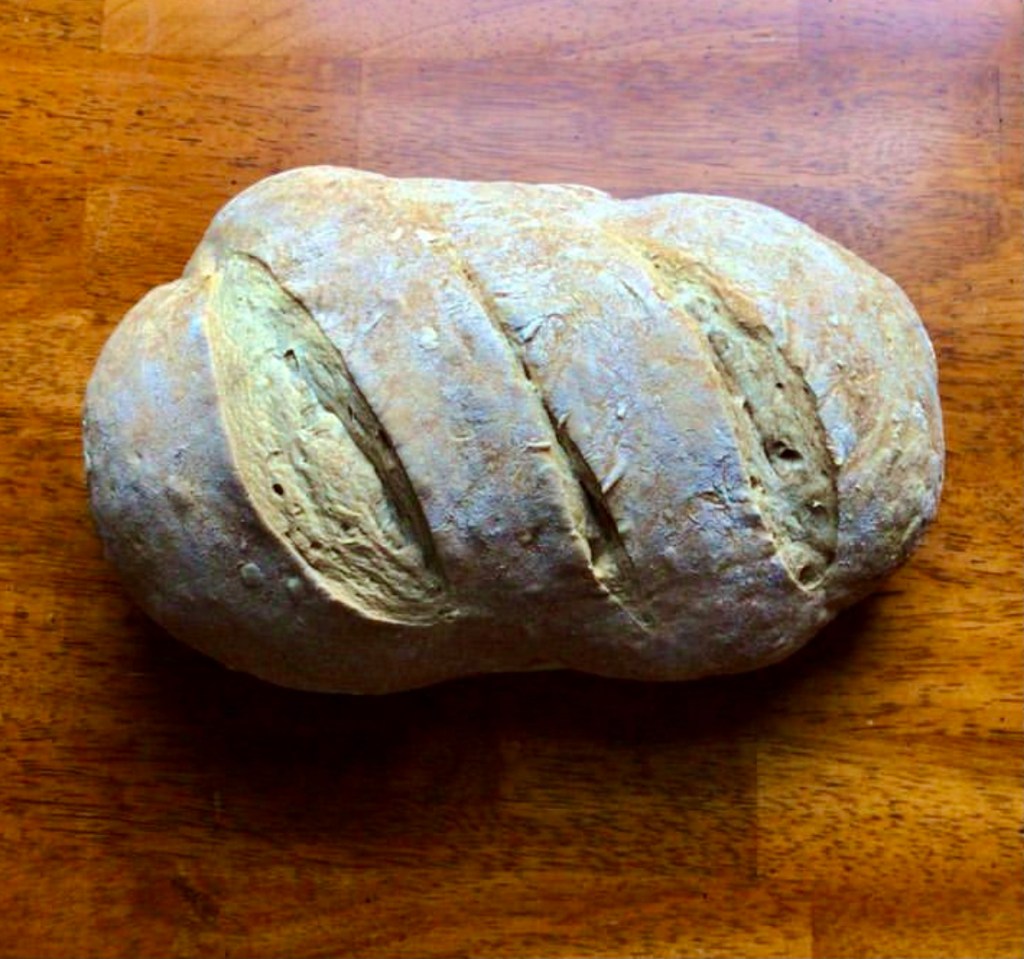
(Photo by author. Full disclosure — this loaf of bread was baked by my husband, several decades later…)


 elizabethlevett
Leave a comment