Years ago, shortly after the death of my dad, I wrote a song called “Flying Circles.” The lyrics are a bit confusing. I was pretty confused. It was a time of questioning for me, of trying to make some sense of things like life and death, and of the nature of the soul. The finality of my dad’s passing wasn’t like anything I’d experienced up to that point, and I found myself in a very tender place, stumbling through my days with some measure of acceptance and a strong dose of compassion. It seemed to me we are all just bits of matter floating around, flying circles of spirit and energy, plus some water and carbon. Somehow we’ve been given the opportunity to love each other for a little while before we change and then disperse. I hadn’t thought about this song in some years.
Recently, those flying circles came back. I was visiting the temples in Kamakura and noticed the beautiful, sweeping circle paintings that have become such a symbol of Zen Buddhist practice and decided to find out more. I did a little research when I got back home and found out the practice of painting the circle goes all the way back to ninth century China. The circle is called the Enso and is considered an expression of enlightenment. It’s supposed to be painted quickly, in one stroke, ideally in one breath, with no revision or correction, using ink and a calligraphy brush on thin paper. The Enso should be painted without distraction, back straight, arm loose, the brush held lightly, perpendicular to the paper surface, the mind should be clear of deliberation or concern for any specific outcome.
It has always seemed to me that the most beautiful, most elegant and expressive paintings are composed quickly; that they’re more gestural than workmanlike, more true somehow. I’m also consistently attracted to exercises that challenge me to let go of control. I decided to paint one circle each day for a month, trying out a variety of brushes with the beautiful, blue-black ink I’d found in Yokohama. Each morning I’d paint a circle before doing anything else. After painting, I found myself remembering something important, or considering an insight that had never occurred to me. Now that the month is nearly over, I want to share some of what came from the practice.
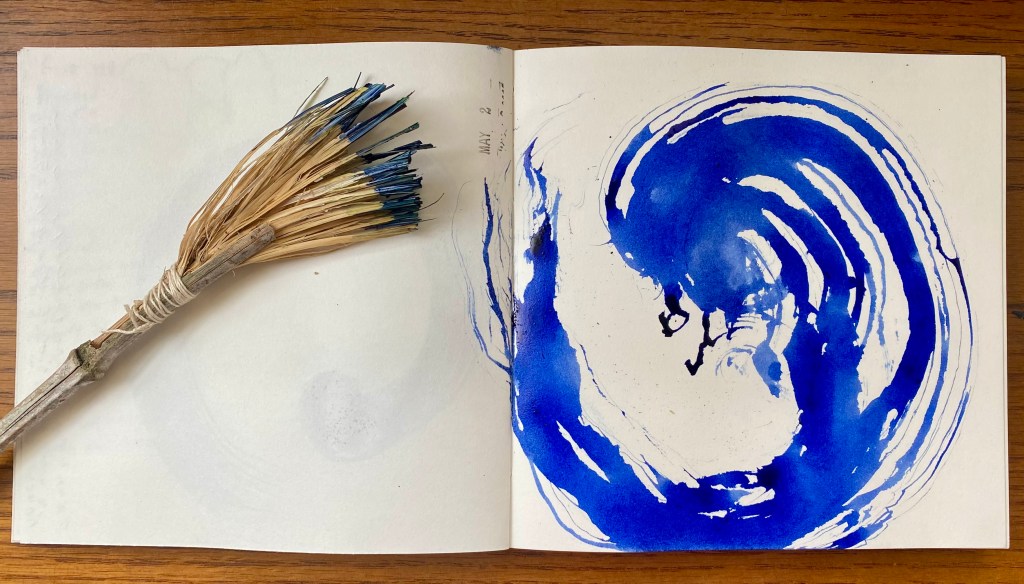
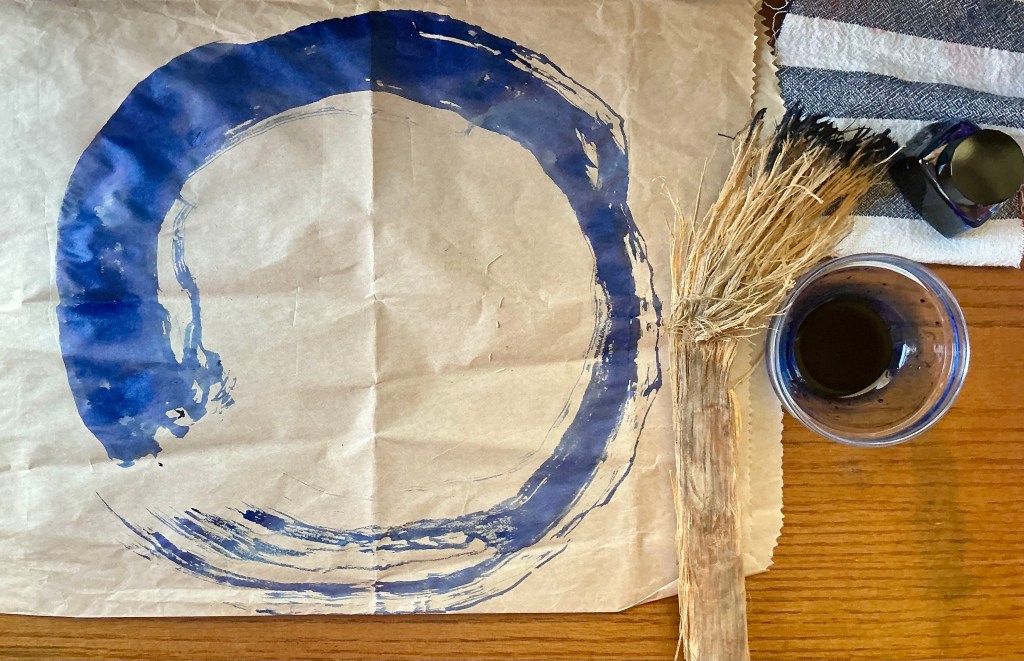
Early on, I painted with a brush I made from a dried, hollow stem and some grass I found while on a beach walk. The result is powerful and free, the circle is open, signifying imperfection rather than completion; the symbol of the soul as a work in progress. The line is strong and exciting. The next day I used a very old Sumi brush and found myself remembering when it was given to me so many years ago. I’d taken third and fourth-grade students to the museum in Balboa Park in San Diego for a brush painting lesson, something I’d completely forgotten. Learning a little about this ancient technique with a group of kids was magical. Since the brush is over forty years old, my expectations were low. Once again, I learned that my expectations can be limiting; that it’s only by opening ourselves up to whatever is possible that we leave room to be astonished by simple beauty.
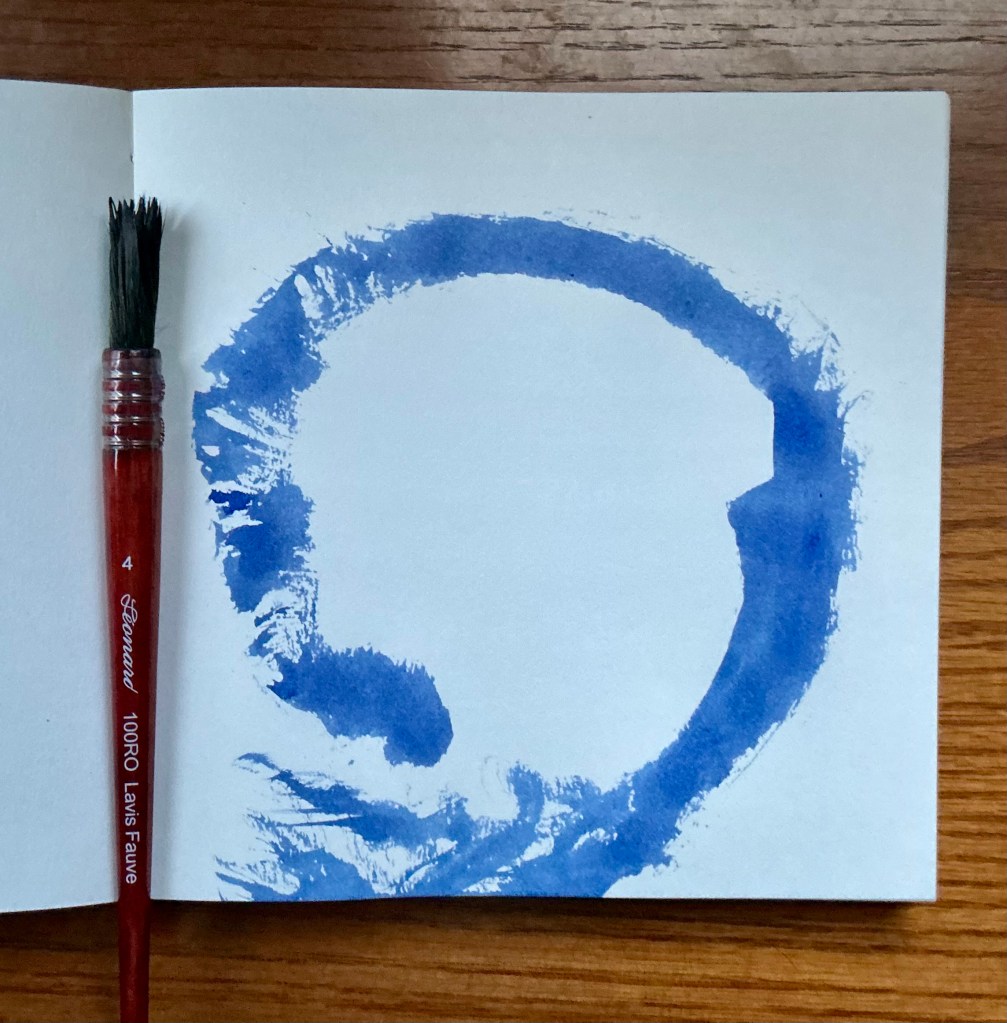
Sometimes, often in fact, the circle can be truly surprising. One day I used a #4 mop brush from France, intended for watercolor. I assumed it would produce a smooth, even line. Instead, the result is quite textured, beautifully wrinkled, like the skin of an elephant. Even the end is frayed like an elephant’s tail. It also seems to suggest a portal to see outward! (Or a port hole?)
One morning, about a week in, I was initially unhappy with the circle. I hesitated halfway and I could see the result of my hesitation, a rupture. It embarrassed me. The circle had actually become a mirror reflecting my imperfection, my lack of trust. Finally, I came to love it for exactly this reason. This is a line that is not strong, nor is it deep. But it is certainly honest. Now I understand that line from Kazuaki Tanahishi, “The quality of the line is what matters most – how deep, how strong, or how honest it is.”
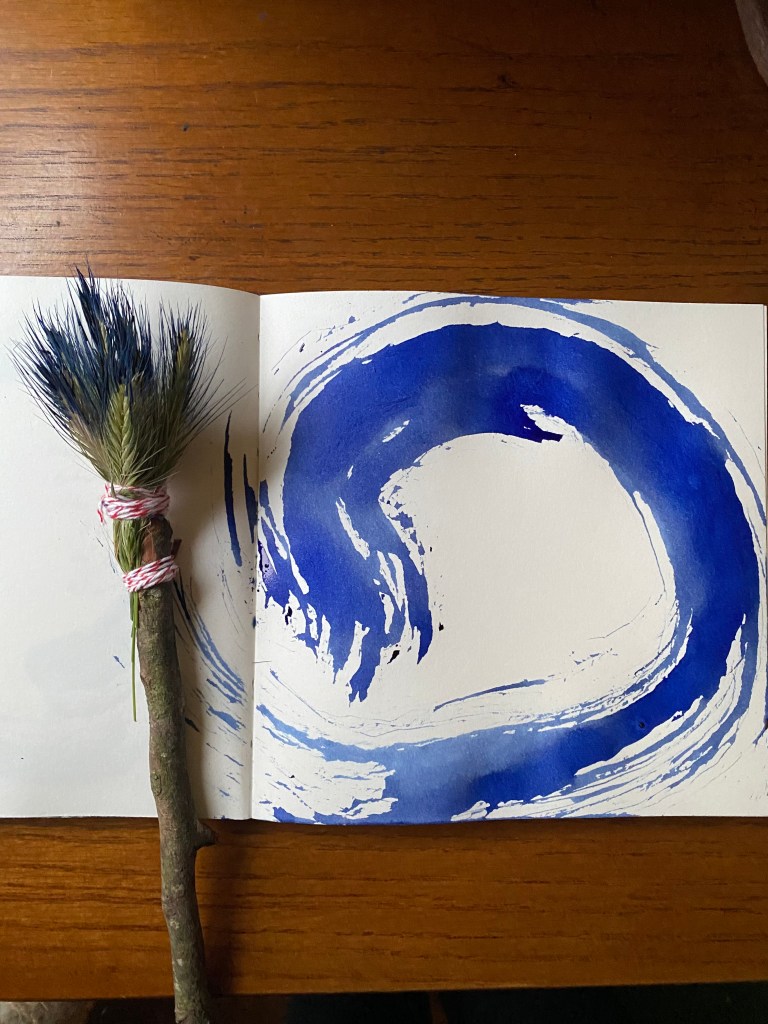
With some of the fat brushes the line gets away from me, it seems I should be working with bigger paper. I love the bold and joyful character of these fat circles, so full of energy and light – the universe in a bubble! One morning I used a huge brush with a generous amount of ink and drew very quickly, splattering ink on the table, the wall, and one of the cats! Another day, I used an improvised brush I’d made from a stick and rye grass. The grasses fell apart in the process but the result is like an ocean wave, so strong and buoyant. On the 13th I got carried away with a tiny brush and made 12 circles! On the 14th I tried out a simple utility brush from the hardware store with a tin handle. The circle came out looking jazzy, with the bold confidence of a vintage advertising font.
By the middle of the month, my circles kept going off the page. Maybe I was getting too excited each day. Maybe I need to cast a wider net around my spirit! At this point I started to associate the act of painting and then examining the result with music. For example, one circle painting brought to mind “The Water Wheel” by Hamsa al Din, as if to suggest that the soul is fluid, in constant motion. Eventually I was able to produce respectably sized circles. Perhaps this indicates a lesson in moderation. If we allow ourselves to plunder through space, things are bound to become unbalanced. Respect for the limitations of a situation leaves room for beauty and harmony.
One of the things inherent in a circle is the empty space inside, indicating the void. I grew up associating emptiness with lack, loneliness, and longing. The void is considered cold, absolute, forbidding. But painting the circles has given me a different perspective on emptiness. An empty space is nothing but possibility. It contains capacity only. There’s room for anything to enter, for anything to leave. Emptiness lacks only completion just as darkness offers space for light. In fact, the word for emptiness, “shunyata,” is referred to in a recent guide (“The Heart Sutra” by Tanahashi and translator Joan Halifax Roshi) as boundlessness, without boundary, without limits.
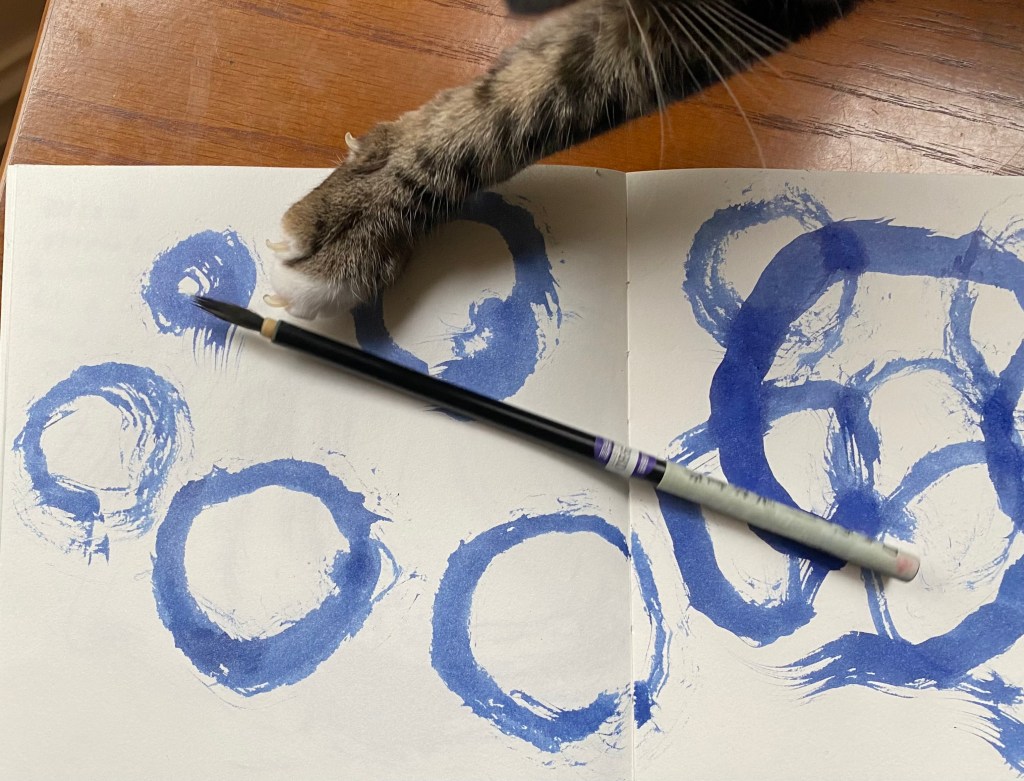
It’s just painting a circle, but it’s also “Fully embodying perfection and imperfection.” (Tanahashi again.) Just like us. Now that the month is almost over, I don’t know if I can stop. I definitely notice the practice is something I look forward to in the morning. A very focused, brief form of meditation, a quick spiritual self-portrait. It’s simple and it’s a way to begin the day with my mind calm, centered, open. It’s also a good way to begin building a daily creative practice. If I don’t have time to do anything else, there’s always enough time to paint a simple circle.
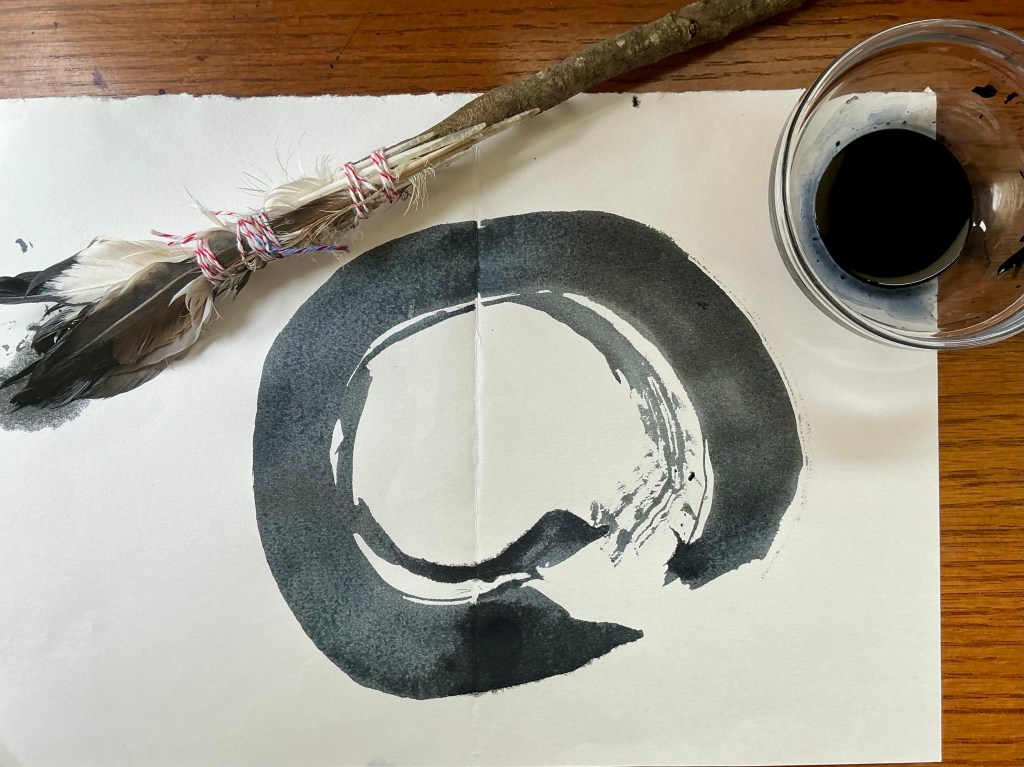
I’ve referred here to Kazuaki Tanahashi. He’s a wonderful artist and activist and his book, Brush Mind (BookSurge Publishing, 2009) is an excellent place to start if you’re interested in learning more. If you decide to try it, get an inexpensive pad of rice paper and a nice, fat calligraphy brush, along with some ink. You can use bottled ink like I did or ask your favorite vendor of art supplies about traditional solid ink which is easy to prepare with a few drops of water. Let me know how it goes and keep going!
And here’s the original song lyric to “Flying Circles,” written about 1988:
Here it came and we walked along, trying to find our hands for the trees
And then later we just rolled past, flying circles in blue.
He was a mighty vision to see – fine eyes, fine teeth
And jumping high and higher, a flying fish he was.
Flying circles we go by.
Now there are feathers around us, and a scratching and a whistling in our ears
But we are found close to the ground, flying circles and we go by.
And the bones and skins of many things we will reveal
And the vision breathes a quickness in our ears.
Flying circles, we go by.


Leave a Reply