So many amazing angles burst upon our eyes.
Sun and moon in a lack-luster turquoise sky.
The setting sun a portent; destined to be an earth.
We have become a moon.
These aspects, cosmic and portentous,
sun and moon traverse the sky.
No charm, no gaiety attends their progress.
She retires.
The flimsy partitions sway
while light signals flash variations on the void.
Here the great bear was completely upside down.
No longer did the moon recall
a burial urn of alabaster.
A world of fairy tales,
a revolving stage.
A magic wand transmuted fauns and panthers.
The sanctuary is honeycombed with grottoes and recesses.
Our journey was teaching us
the elasticity of time.
Nature at her most lavish; no less intricate than the forms of things.
The sea ran high.
Splashes of light, wisps of glowing pink
that vanished like phantoms,
flecked the darkening sky.
The dim and drenching air was faceted
with broken lights, tremulous with mirage.
Strong, secret, motives lie
behind the myriad details that make up
the teeming beauty of the world.
The horizon blazed with green magnesium flares,
soundless bursts of distant lightning.
Time; know it for the hollow fraud it is.
Like the lines a child cuts in the crease of a folded
and refolded piece of paper,
the pattern of a filigree takes form;
within the pattern of a life.
That seeming chaos and disorder is composed of order.
How can we not marvel at the way that life,
so fragile yet so obdurate,
has made itself at home in every corner of the globe?
The pageantry of storm and cloud that night
was older than the hills, yet new to us,
traveling through the thick of it.
We saw new stars added to the firmament,
new gulfs of darkness added to the night.
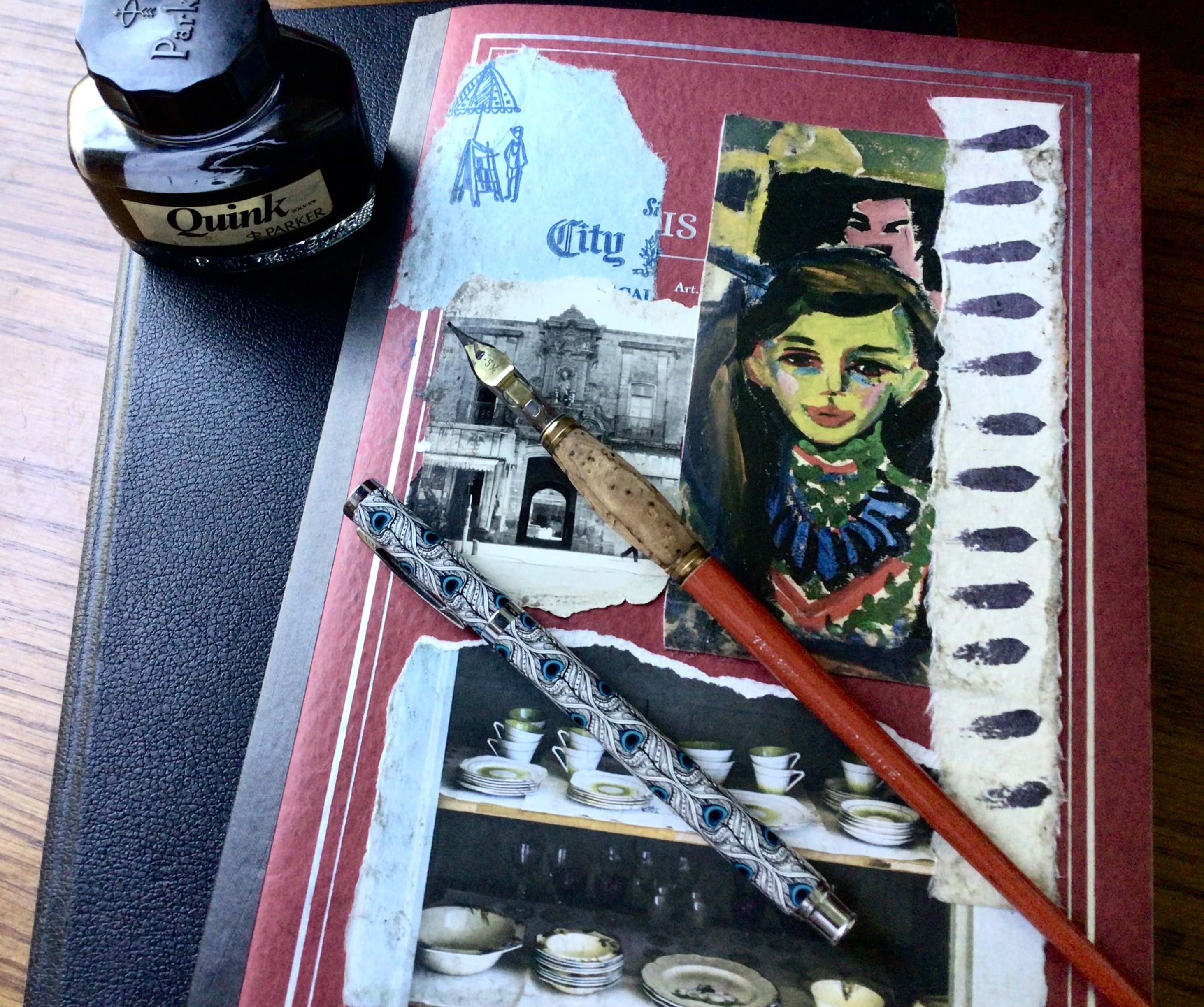
“The Voyage” is composed as a found poem. Found poetry is the practice of selecting words, phrases, even entire sentences, from an existing work and assembling these into a new piece. I like to think of a found poem as a collage with words.
In 1936, Jean Cocteau decided to re-enact Jules Verne’s journey with his partner, Marcel Khill. Cocteau traveled from Europe to Greece, then on to Egypt, India, and East Asia. From Japan they flew on to Hawaii and then to San Francisco. From there they crossed the U.S. by air, spent some time in New York, and finally returned to Europe in time. Cocteau’s book, Round the World Again in 80 Days, is as a fascinating compilation of his observations on the natural world, as well as commentary on class difference and the human condition. In selecting passages, I tended to limit my focus on the visual magic he found. I have not added any words but I have made a few alterations of punctuation and conventions where necessary.
Source: Round the World Again in 80 Days (Mon Premier Voyage), Jean Cocteau
London; New York: Tauris Park Paperbacks: distributed by Martin’s Press 2000
Originally published in French, 1937, composed of dispatches written from Cocteau’s travels in 1936 for Paris-Soir.


Leave a Reply